Open your counselling website and read the first screen as someone who is not okay. Not as the therapist who built it. As the person who found it at 11pm because something is wrong and they do not have the words for it yet.
Most counselling and therapy homepages answer that person with a list: accredited psychotherapist, CBT, ACT, EMDR, psychodynamic, integrative, person-centred. It is accurate, and it is meaningless to someone who is frightened and does not know what any of those words mean. They came to say “I can’t sleep” or “my marriage is falling apart,” and the page answered in a language they do not speak.
Why doesn’t a list of therapy modalities bring in new clients?
A first-time client does not know what CBT, ACT, or EMDR mean, and is in no state to research them. They arrive anxious, describing a problem in plain words. A page that answers with acronyms and approach-names gives them nothing to recognise themselves in, so they keep looking for someone who sounds like they understand what is actually happening to them.
The modality list is not wrong, it is just written for the wrong reader. It reassures other clinicians and referrers that you are properly trained. The person deciding whether to reach out is not assessing your training yet. They are trying to work out whether you understand their problem and whether contacting you will feel safe. The list answers neither.
What does an anxious first-time client actually read for?
Recognition and safety. They scan for their own experience described back to them, “I can’t switch my brain off,” “we keep having the same fight,” “I feel nothing,” and for signs that reaching out will not be overwhelming or judged. They are not evaluating credentials in that first minute. They are deciding whether you get it, and whether the first step is small enough to take.
The language you use versus the language they use
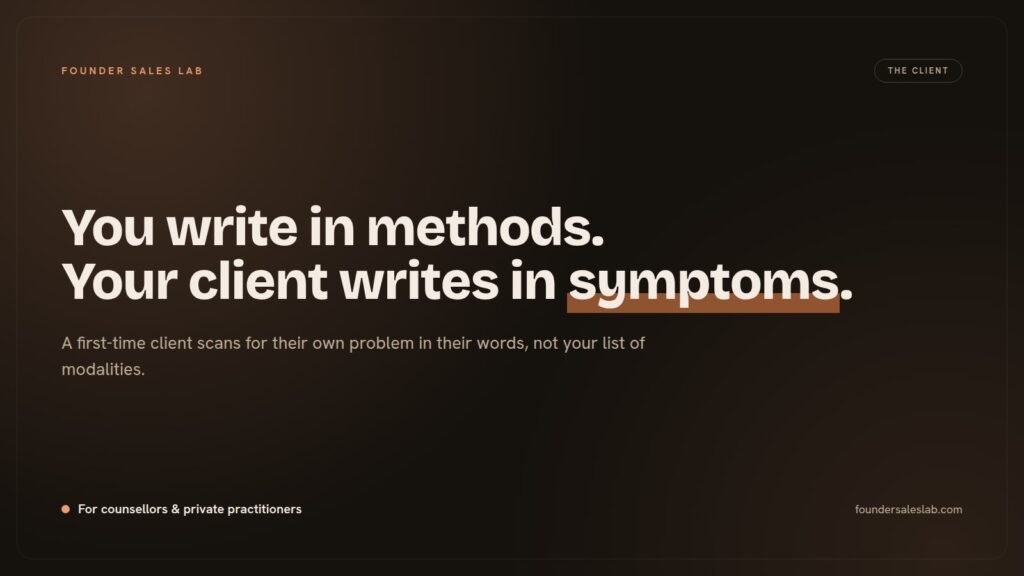
You write in modalities: CBT, ACT, EMDR, integrative, person-centred, psychodynamic. Your client writes and searches in symptoms and situations: cannot sleep, panic before work, grief that will not lift, my relationship is ending. Both describe the same work. Only one is the language the frightened person at midnight actually types into a search bar and reads. Meet them in theirs, and keep the modality names for the part of the page they reach once they already trust you.
How do you write a counselling website that speaks to the client?
Lead with their presenting problem in their own words, tell them plainly that this is what you help with, and make the first step feel small and safe. Keep your training and modalities lower on the page for the reader who wants them. Recognition and safety first, credentials second. You are not dumbing anything down, you are speaking to the person before the clinician.
Here is the shape of it.
Before, a typical homepage opening: “I am an accredited psychotherapist offering CBT, ACT, EMDR, and psychodynamic therapy, with an integrative, person-centred approach.”
After: “If you are lying awake at 3am with your mind racing, or dreading Monday, or snapping at the people you love and not knowing why, that is what I help with. We work out together what is going on and what actually helps. You do not need to have the words for it yet.”
The before lists what you are trained in. The after names the client’s own experience and quietly lowers the bar to making contact. A person who is not okay reads the second one and feels, maybe for the first time that evening, that someone understands.
One more place it leaks: the contact step. “Book an initial assessment” sounds clinical and large to someone unsure they even should. “Send me a short message about what is going on and I will reply with whether I am the right person to help” makes the first move small. Lower the cost of that first contact and more people will make it.
If you want to see where your own page is speaking in your language instead of your client’s, that is what the 60-Second Homepage Audit is for. It is $199, and it comes off the price in full if you go on to a build.
What should a counselling or therapy website homepage say?
Lead with the client’s problem in their own words, say plainly that this is what you help with, and make the first contact feel small and safe. Keep your modalities and training lower down. Recognition and safety first, credentials second.
Should I list my therapy modalities (CBT, ACT, EMDR) on my website?
Yes, but not at the top. A first-time client rarely knows what they mean and is not in a state to research them. Put them further down for the reader who wants them, and open with the experience the client actually recognises.
Why is my counselling website not getting new client enquiries?
Often because it describes your approach instead of the client’s problem. An anxious person scanning late at night needs to see their own experience named and a safe, low-pressure way to reach out. If neither is near the top, they keep looking.